Bearing internal clearance refers to the total distance through which one bearing ring can move relative to the other ring before mounting.
This movement can occur either in the radial direction (radial internal clearance) or in the axial direction (axial internal clearance).
Internal clearance is one of the most important parameters affecting bearing operating performance, service life, temperature rise and vibration stability.
Selecting the proper clearance group is critical for heavy-duty industrial applications such as
vibrating screen bearings,
mining machinery, crushers, rolling mills and cement equipment.
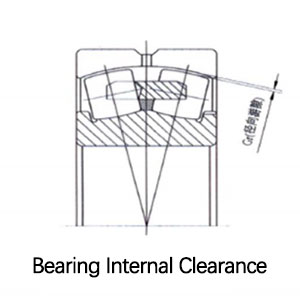
Radial Clearance vs Axial Clearance
Bearing internal clearance is generally divided into:
- Radial Internal Clearance – the total movement of one ring relative to the other in the radial direction.
- Axial Internal Clearance – the total movement in the axial direction.
For most rolling bearings, radial internal clearance is the primary factor considered during bearing selection and installation.
Initial Clearance and Working Clearance
The clearance measured before installation is called the
initial internal clearance.
After mounting and during operation, the actual clearance becomes smaller due to:
- Interference fits between shaft and housing
- Thermal expansion of bearing rings
- Temperature differences during operation
- Heavy radial or axial loads
The remaining clearance during operation is called the
working clearance or
operational clearance.
Proper working clearance is essential for preventing excessive heat generation, premature fatigue and abnormal vibration.
What are C3 and C4 Bearing Clearance?
Bearing clearance groups define the amount of internal clearance compared with Normal clearance.
Common clearance classes include:
-
Normal Clearance –
standard clearance suitable for most industrial applications -
C3 Clearance –
greater than Normal clearance, widely used in electric motors, mining equipment and heavy-duty machinery -
C4 Clearance –
larger than C3, mainly used in high vibration and high temperature applications such as vibrating screens and crushers
For example, many 223 Series spherical roller bearings
used in vibrating screens are often customized with C4 clearance to compensate for severe vibration and shaft deflection.
Why Internal Clearance is Important
Improper bearing clearance may lead to serious operating problems:
- Excessive temperature rise
- Increased vibration and noise
- Lubrication failure
- Premature bearing fatigue
- Reduced bearing service life
Different bearing types require different operational clearance conditions:
-
Ball Bearings –
typically operate with near-zero clearance or slight preload -
Spherical Roller Bearings –
usually require residual operational clearance -
Cylindrical Roller Bearings –
normally maintain a small residual clearance during operation -
Tapered Roller Bearings –
may use preload in stiffness-sensitive applications
How to Select Proper Bearing Clearance
The correct bearing clearance depends on multiple operating conditions:
- Shaft and housing fit tolerance
- Operating temperature
- Rotational speed
- Load conditions
- Vibration intensity
- Lubrication method
For high vibration applications such as vibrating screen equipment,
larger clearance groups like C4 are commonly recommended.
WJY Bearings provides customized clearance solutions including Normal, C3 and C4 clearance for mining, cement, steel and heavy industrial equipment.
Conclusion
Bearing internal clearance directly affects bearing reliability, operating temperature, vibration performance and service life.
Understanding the difference between initial clearance and working clearance helps engineers select the proper bearing configuration for demanding industrial applications.
If you need technical support for selecting the correct bearing clearance for vibrating screens, crushers or heavy machinery,
please contact WJY Bearings for professional assistance.