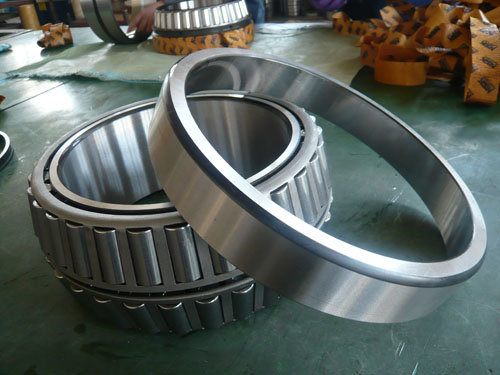
A tapered roller bearing is a type of rolling-element bearing designed to handle both radial loads and axial (thrust) loads simultaneously. Its unique geometry—using conical rollers and raceways—makes it one of the most widely used bearing types in heavy-duty industrial applications.
From mining equipment and gearboxes to automotive axles and steel mills, tapered roller bearings are engineered for applications where high load capacity, durability, and alignment stability are critical.
Working Principle
A tapered roller bearing consists of four main components: inner ring (cone), outer ring (cup), tapered rollers, and a cage.
- Tapered rollers align so their contact lines meet at a common point on the bearing axis.
- This geometry allows the bearing to distribute loads evenly across the roller length.
- It can withstand combined radial and axial loads better than cylindrical bearings.
Because of this design, tapered roller bearings are commonly used in applications involving heavy shock loads and misalignment risk.
Structure Components
Inner Ring (Cone)
Mounted on the shaft and supports the rolling elements.
Outer Ring (Cup)
Fixed in the housing and forms the outer raceway.
Tapered Rollers
Carry load and reduce friction through rolling motion.
Cage (Separator)
Keeps rollers evenly spaced and improves stability.
Main Types
- Single-row tapered roller bearings – Most common, used in automotive and gear systems.
- Double-row tapered roller bearings – Higher load capacity, used in heavy machinery.
- Four-row tapered roller bearings – Designed for rolling mills and extreme load environments.
- Matched bearings (DF/DB/DT configurations) – Used for precise axial load control.
Where Tapered Roller Bearings Are Used
They are widely applied in industries requiring high durability and load resistance:
- Mining and crushing equipment
- Steel rolling mills
- Gearboxes and reducers
- Automotive wheel hubs and axles
- Construction machinery
Key Benefits
- Handles combined radial and axial loads
- High load-carrying capacity
- Adjustable clearance and preload
- Long service life under heavy-duty conditions
- Suitable for shock and impact loads
Although highly efficient, tapered roller bearings require proper installation and adjustment. Incorrect preload or misalignment can lead to overheating and premature failure.
How to Choose the Right Tapered Roller Bearing
- Check radial and axial load requirements (Cr / Cor)
- Determine speed conditions
- Consider mounting space limitations
- Select correct series (e.g., 302, 303, 322, 313 series)
- Evaluate lubrication and sealing conditions
Explore our full range of high-quality tapered roller bearings:
Tapered roller bearings are essential components in modern heavy machinery, offering a reliable solution for combined load conditions. Their durability, precision design, and wide industrial usage make them one of the most important bearing types in engineering applications.
Choosing the right specification and manufacturer ensures long-term performance and reduced maintenance costs.