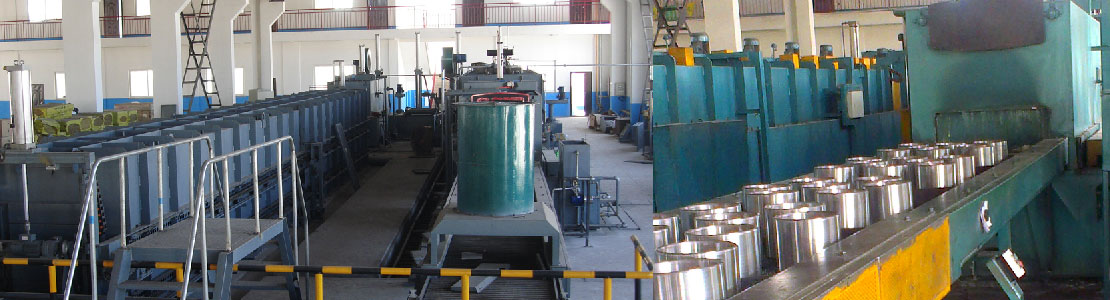
Continuous heat treatment production line for large industrial bearing rings at WJY Bearing manufacturing facilities.
In the manufacturing of heavy-duty industrial bearings, heat treatment is one of the most critical processes affecting bearing performance, service life and reliability.
For large spherical roller bearings, cylindrical roller bearings and other heavy-load bearing products, proper heat treatment directly determines hardness, wear resistance, impact strength and dimensional stability.
At WJY Bearing in Wafangdian, China, heat treatment plays an essential role throughout our bearing production process.
Why Heat Treatment Is Important for Bearings
Industrial bearings often operate under:
- Heavy radial and axial loads
- High temperature environments
- Strong vibration and shock loads
- Dust and contamination conditions
- Continuous high-speed rotation
Without proper heat treatment, bearing rings and rollers may suffer from:
- Premature wear
- Surface fatigue
- Cracking
- Deformation
- Reduced service life
Key insight: For this reason, different heat treatment technologies are applied according to bearing type, steel material and working conditions.
Annealing Process in Bearing Manufacturing
Annealing is usually the first important heat treatment step after forging or rolling.
The purpose of annealing is to:
- Reduce internal stress
- Improve machinability
- Refine grain structure
- Prepare the material for subsequent machining and quenching
In bearing manufacturing, several annealing methods are commonly used.
Spheroidizing Annealing
Spheroidizing annealing is widely used for bearing steel and high-carbon alloy steel. This process helps transform carbide structures into spherical particles, improving cutting performance and reducing the risk of cracking during quenching. For large bearing rings and rollers, proper spheroidizing treatment is especially important for dimensional stability.
Stress Relief Annealing
Large industrial bearing rings may generate residual stress during forging and rough machining. Stress relief annealing helps eliminate internal stress and reduce deformation during later grinding and heat treatment processes.
This is particularly important for:
- Rolling mill bearings
- Crusher bearings
- Vibrating screen bearings
- Large slewing bearings
Quenching Process for Heavy Duty Bearings
Quenching is the key process for improving bearing hardness and wear resistance. By heating steel to the appropriate temperature and rapidly cooling it, martensitic structures can be obtained to enhance mechanical properties.
Different quenching methods are selected according to bearing size, material and precision requirements.
Oil Quenching
Oil quenching is commonly used for industrial bearings because it provides stable cooling while reducing cracking risks. Compared with water quenching, oil quenching offers better dimensional control for precision bearing components.
Double Medium Quenching
For large bearing rings requiring both hardness and reduced deformation, double-medium quenching may be adopted. This process combines rapid cooling and controlled cooling to balance hardness and structural stability.
Austempering & Controlled Cooling
For some heavy-load bearing applications, controlled cooling processes are used to improve toughness and reduce internal stress. This helps bearings maintain stable performance under impact loads and vibration conditions.
Tempering Process for Bearing Performance
After quenching, bearing steel becomes very hard but also brittle. Tempering is therefore necessary to:
- Reduce brittleness
- Eliminate quenching stress
- Improve toughness
- Stabilize bearing dimensions
Different tempering temperatures produce different performance characteristics.
Low Temperature Tempering
Low temperature tempering is widely used for bearing steel. This process maintains high hardness and wear resistance while reducing internal stress. It is commonly applied in:
- Spherical roller bearings
- Cylindrical roller bearings
- Tapered roller bearings
High Temperature Tempering
For some heavy machinery applications requiring improved toughness and impact resistance, higher tempering temperatures may be used. This helps bearings achieve a balanced combination of:
- Strength
- Toughness
- Fatigue resistance
Heat Treatment and Bearing Quality
In modern bearing manufacturing, heat treatment is not simply a heating process. It requires strict control of:
- Temperature
- Heating time
- Cooling speed
- Furnace atmosphere
- Hardness inspection
- Metallographic structure
At WJY Bearing manufacturing facilities, heat treatment processes are carefully controlled to ensure stable quality and reliable bearing performance for heavy industrial applications.
Applications of Heat Treated Industrial Bearings
Proper heat treatment technology is essential for bearings used in:
- Rolling mills
- Mining equipment
- Cement plants
- Vibrating screens
- Crushers
- Heavy gearboxes
- Metallurgical machinery
These industries require bearings capable of operating continuously under severe working conditions.
Conclusion
Heat treatment is one of the core technologies in industrial bearing manufacturing. From annealing and quenching to tempering, every process directly affects bearing reliability, service life and operating performance.
For heavy-duty industrial bearings, selecting the correct heat treatment process is just as important as bearing design and material selection.
WJY Bearing continues to optimize bearing heat treatment technologies to provide durable and cost-effective bearing solutions for global industrial customers.